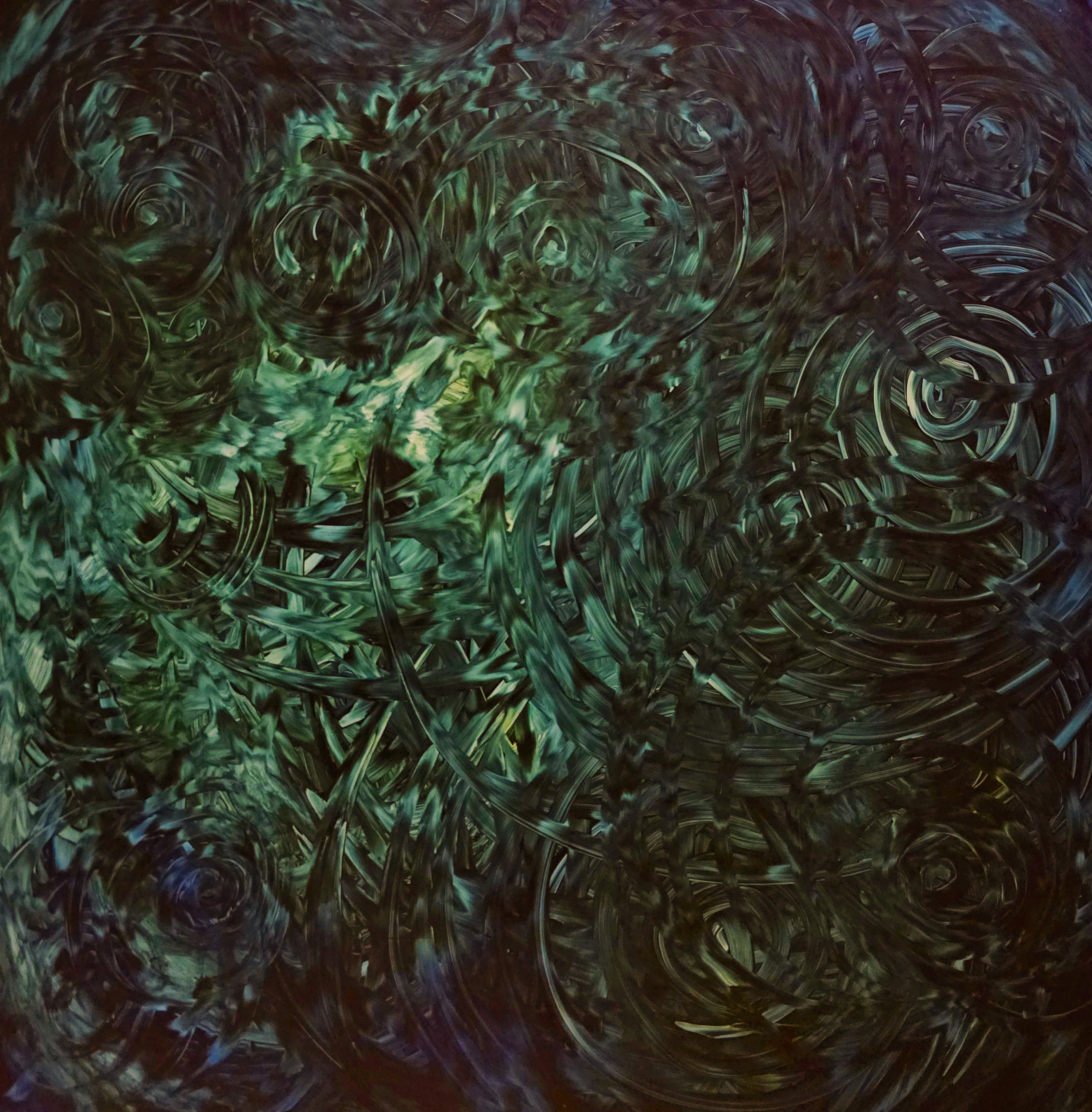

It lies in not drawing what I already know.
Whenever someone stands in front of one of my paintings, there is an almost irresistible urge to search for recognition. Is that an eye? A face? A flower? A tree? A leaf? We are pattern-making creatures. We are comforted by familiarity. We want to find something we can name.
The temptation exists for the artist as well.
It is remarkably easy, while drawing, to notice a shape emerging and think, “Ah, that looks like a figure.” Once that happens, the hand begins to serve the idea. The drawing starts to become something recognizable. Before long, the painting is no longer discovering itself. It is illustrating something already known.
For more than thirty years, I have been working on a different practice.
I try to draw without instructing the drawing what it should become. I try to allow the movement of the hand, the rhythms of the body, the associations of memory, and the activity of the subconscious mind to find their own way onto the surface. Instead of beginning with an image, I begin with attention.
Recently, I have come to understand that this process bears a striking resemblance to some of the ancient Vedic teachings on meditation. Most people think meditation is about emptying the mind. Yet recently I was reminded that in the classical Vedic tradition, emptying the mind is not the goal and it is certainly not the starting point. The foundation is concentration. The Sanskrit word for concentration is dharana. The word for meditation is dhyana. They are not the same thing, and I must thank Johnny Dolphin and Bobby Cherian for this portal into helping me to understand my mind and painting process more deeply.
Dharana comes first. One learns to place attention somewhere and keep it there. Only then can meditation emerge. This distinction has become increasingly important in how I understand my work. Painting, for me, is not an act of expression as much as an act of concentration. Not concentration on an object. Concentration on the process itself. On the movement of the hand. On the unfolding of a line. On the appearance of a shape before it acquires a name. The challenge is not to stop thinking. The challenge is to remain present long enough for something deeper than thought to emerge. The Vedic traditions recognized that the mind rarely settles into stillness on its own. It needs something to hold. Something meaningful. Something capable of gathering scattered attention into a single stream.
This is known as Saguna practice. Saguna means “with qualities” or “with form.” Traditionally, a practitioner might focus on a deity, a sacred image, a mantra, a flame, or a symbol. The object itself is not necessarily the destination. It is a vehicle. A means of training attention. The practitioner learns to return to it again and again. Patiently. Repeatedly. Lovingly. Over time, concentration deepens. The mind becomes steadier, more unified, less distracted by every passing thought.
As I learn more about these teachings, I realize that drawing itself has become a kind of Saguna practice for me.
The line is the object. The mark is the object. The movement is the object. Again and again I return to it. The drawing becomes an anchor for attention. Not because I am trying to produce a specific image, but because the act of drawing gathers the mind into the present moment. The paradox is that while I am working very hard to concentrate, I am simultaneously trying not to impose an outcome.
This is where the real challenge begins.
The mind constantly wants to organize, categorize, and identify. It wants to convert mystery into certainty. It wants to tell a story. It wants to make an object. The moment a shape appears, the mind rushes to name it.
A face. An eye. A bird. A leaf. A tree. A flower. A root.
The naming happens almost instantaneously. Yet what if the naming is premature? What if the image has not yet become itself? What if the thing that is emerging is something the conscious mind has never encountered before? This requires a different kind of discipline. A willingness to remain with the form without collapsing it into a conclusion.
In Vedic meditation, there comes a stage when the object of concentration begins to dissolve. The practitioner starts with form but does not remain there forever. The image expands. The mantra fades. The symbol dissolves. What remains is awareness itself.
This movement is called Nirguna.
Nirguna means “without qualities,” “without attributes,” or “formless.” The practitioner moves from concentrating on something to resting in the field from which all things arise. When I first encountered this idea, I immediately recognized something familiar. It described moments that occasionally occur while painting. Not often, not predictably, certainly not on demand. But enough times to recognize them. There are moments when the painting ceases to feel like an object I am making.
The distinction between observer, painter, brush, and painting becomes less rigid.
Time changes…the usual internal commentary quiets. The need to explain vanishes. The work seems to move through me rather than from me.
I hesitate to describe these experiences because language inevitably distorts them. Yet many artists, musicians, dancers, writers, and craftspeople speak of similar states. The Vedic traditions would perhaps describe this as moving from concentration toward absorption. From form toward the formless. From effort toward participation. What fascinates me is that the path begins not with transcendence but with attention. Not with mystical experiences. Not with altered states. But with the simple discipline of returning.
Returning to the mark. Returning to the line. Returning to the drawing.
Again and again. Over the years I have realized that much of contemporary life trains us in precisely the opposite direction. Our attention is fragmented; we are pulled in multiple directions simultaneously; we are rewarded for speed rather than depth; we are encouraged to react rather than observe.
The Vedic teachers understood that a scattered mind struggles to perceive reality clearly.
I believe the same is true in art; a scattered mind tends to produce familiar images-it reaches for habits, for formulas, for certainty, for things already known. A concentrated mind can tolerate ambiguity; it can remain in uncertainty without immediately trying to escape it. This is where discovery becomes possible!
What emerges when the hand is not trying to describe a flower? What forms arise when the drawing is not required to become a landscape, a face, or a tree? What intelligence exists in the body that precedes language and naming?
These questions have guided much of my work. Of course, traces of the natural world still appear. How could they not? I have spent my life immersed in forests, rivers, coral reefs, seeds, bark, fungi, roots, and vines. The forms of nature live within me. But I try not to summon them deliberately.
If they emerge, they emerge. If they dissolve into something else, I let them go. This willingness to let forms appear and disappear feels increasingly important. The Vedic teachings suggest that forms are not obstacles to truth. They are gateways. One begins with form because that is where human beings naturally live, but one does not become trapped by form. The form teaches concentration. The concentration opens perception, and perception reveals something larger than the form itself.
I find this profoundly relevant to artistic practice.
The painting begins with marks. But the marks are not the destination. The image begins with shapes. But the shapes are not the destination. The destination—if there is one at all—is a deeper encounter with awareness itself. A deeper encounter with seeing. A deeper encounter with being present.
The challenge is remaining faithful to the process rather than the outcome.
There is a subtle pressure from the audience—and often from the artist’s own expectations—to provide recognizable landmarks. We are rewarded when people can say, “I know what that is.” We are less comfortable when the work refuses immediate translation. Yet some of the most important experiences in life arrive before we have words for them.
Wonder arrives before language.
Grief arrives before language.
Love arrives before language.
Awe arrives before language.
The experience is primary, the explanation comes later…why should painting be any different?
I am not interested in making pictures of things.
I am interested in creating a space where something can appear that neither the viewer nor I anticipated. The paintings become records of an encounter rather than illustrations of an idea. They document a conversation between concentration and surrender.
Between attention and emergence.
Between form and formlessness.
Between the known and the unknown.
The longer I paint, the more I believe that creativity depends upon our willingness to remain in that threshold space. Not rushing toward certainty, not clinging to explanation, not forcing meaning to arrive before it is ready. The creative process asks us to remain with the question; to trust the question.
To trust that not knowing is not a deficiency but a condition of discovery.
Perhaps this is why I continue to paint. Not because I have found answers, but because painting repeatedly returns me to a place where answers are not required. A place where forms emerge and dissolve. A place where certainty loosens its grip. A place where mystery is not a problem to solve but a reality to inhabit.
That, for me, is where courage lives- not in making bold marks, not in exhibiting work, not in knowing what I am making -but in allowing myself not to know.
In trusting concentration more than intention. In trusting attention more than control.
And in trusting that if I remain present long enough, something wiser than my plans may eventually reveal itself.
22nd June 2026
Thank you to Bobby Cherian for Vedic Insights (https://www.jyotisakti.com/)
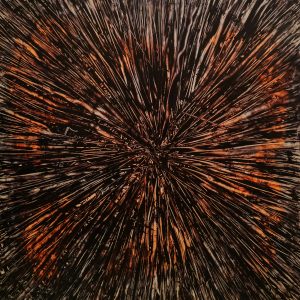
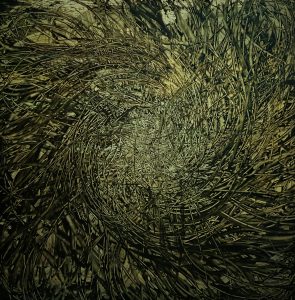
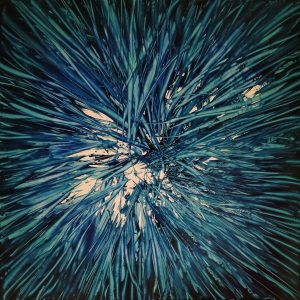
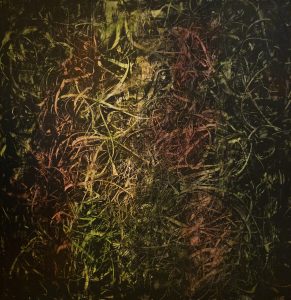
Paintings from ATLAS OF INNER BLOOMING BIOMES
A Fictional Herbarium Catalogue of Inner and Outer Expeditions
Paintings by 3t Vakil | Collected Specimens, June 2025 onward